How Long Does It Take to Evict a Tenant in New York? The Real Timeline and Cost for Long Island Landlords (2026)
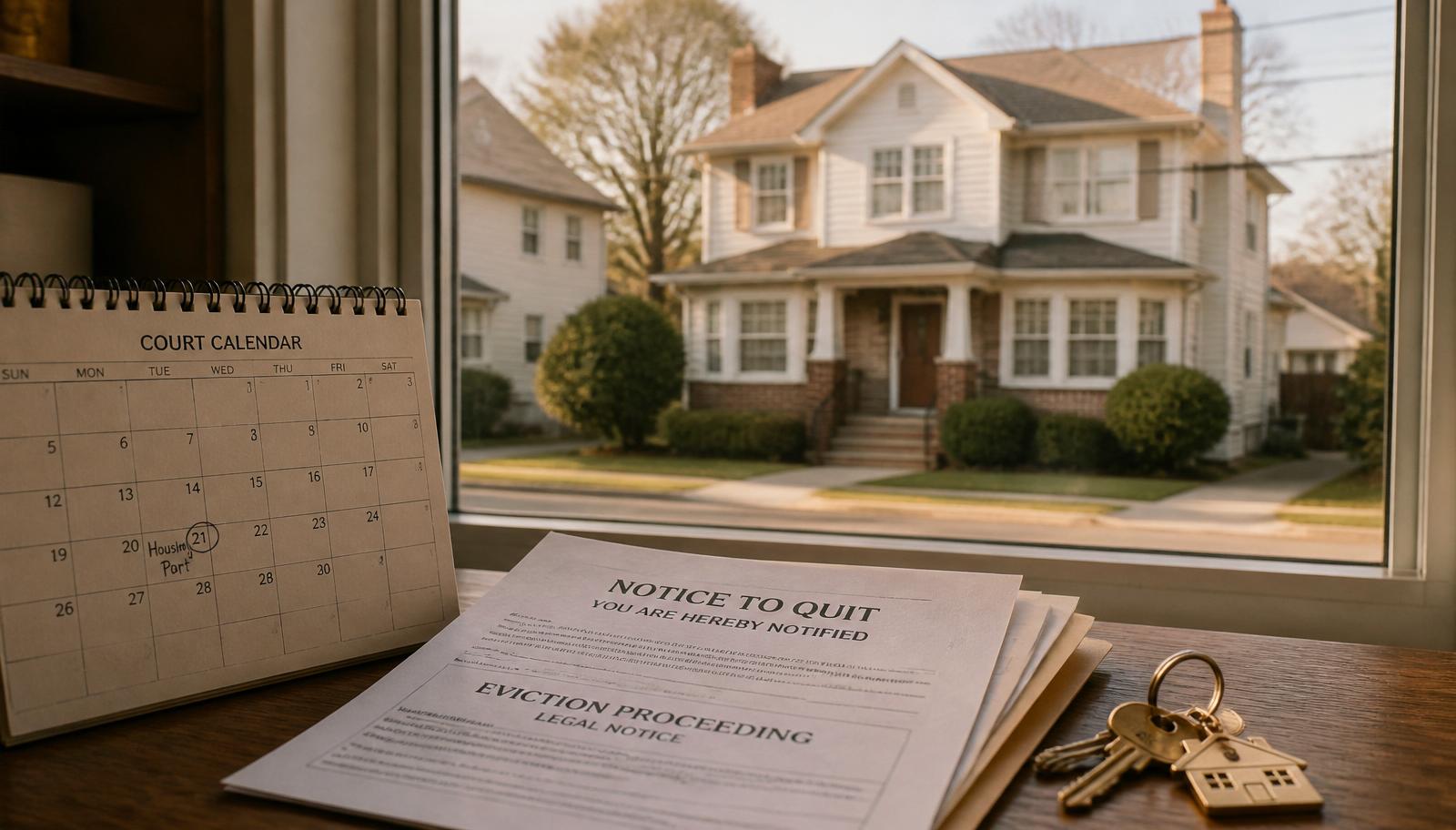
In New York, evicting a tenant usually takes 3 to 6 months from the first required notice to the sheriff or marshal executing the warrant, and contested cases on Long Island often run six months to a year or more. New York law requires a specific written notice before you can even file (a 14 day rent demand for nonpayment, or a 30, 60, or 90 day termination notice for a holdover depending on how long the tenant has been there), then a court proceeding, a judgment, a warrant of eviction, and a final 14 day notice before the lockout. Every step has a deadline, and a defective notice sends you back to the beginning.
Key Takeaways
- A realistic New York eviction timeline is 3 to 6 months for a straightforward nonpayment case and six months to a year or more when the tenant fights, requests adjournments, or wins a discretionary stay.
- The Housing Stability and Tenant Protection Act of 2019 rewrote the process end to end: a 14 day written rent demand under RPAPL 711, a 30, 60, or 90 day termination notice under RPL 226-c based on length of tenancy, and a 14 day warrant notice under RPAPL 749 before the lockout.
- Self-help eviction is illegal everywhere in New York. Changing the locks, removing belongings, or shutting off utilities exposes a landlord to damages, including treble damages under RPAPL 853.
- In a nonpayment case, a tenant who pays the full rent due before the hearing stops the case, because RPAPL 731 requires the landlord to accept it.
- Courts can stay an eviction for up to one year under RPAPL 753 where the tenant shows hardship, which is the single biggest wild card in the timeline.
- The most expensive part of an eviction is rarely the court costs. It is the months of unpaid rent while the case runs, which is why notice mistakes that restart the clock are the true budget killer.
How long does it take to evict a tenant in New York?
Evicting a tenant in New York usually takes 3 to 6 months from the first required notice to the actual lockout, and contested cases commonly take six months to a year or more. The minimum is set by mandatory waiting periods in the statutes themselves: 14 days for a rent demand, 10 days for the tenant to answer, and 14 days of warrant notice, plus court scheduling between each step.
In my practice on Long Island, I tell landlords to budget a full season, not a few weeks. Nassau and Suffolk County District Courts handle these cases on crowded calendars, and every appearance, adjournment, and motion adds weeks. A tenant who simply shows up and asks for time will usually get some. A tenant with a lawyer, or one who raises repair issues, rent disputes, or a hardship claim, can stretch the case well past a year.
The hard truth for landlords is that the timeline is mostly out of your control once the case is filed. What is entirely in your control is whether the case survives on the paperwork you served before filing. The single most common reason a New York eviction takes a year instead of four months is not a clever defense lawyer. It is a landlord who served the wrong notice, or served the right notice the wrong way, and had to start over. Get the front end perfect and the back end usually takes care of itself.
What notice do I have to give a tenant before eviction in New York?
For nonpayment of rent, New York requires a written demand for the rent at least 14 days before starting the case under RPAPL 711. To end a tenancy without a lease violation, RPL 226-c requires written notice of 30 days if the tenant has been in the unit less than one year, 60 days for one to two years, and 90 days for two years or more. Oral demands no longer count for anything.
These notices are where cases are won and lost. The 14 day rent demand must state the amount owed and the period it covers with reasonable accuracy, and it must be served the way the statute requires, not just handed over or taped to the door however is convenient. The 30, 60, and 90 day notices under RPL 226-c also apply when you decline to renew a lease or raise the rent by five percent or more, which surprises many Long Island landlords who assumed a lease simply ending was enough.
I review notices for landlords who drafted their own, and more than half have a defect I would attack if I were on the other side. A wrong dollar figure, a demand signed by a manager without authority, a notice period counted from the wrong date. Each one is a dismissal waiting to happen, and a dismissal means new notice, new filing fee, and two more months of a tenant not paying rent. Paying counsel to draft one notice correctly is the cheapest insurance in this entire process.
What are the steps of a New York eviction, start to finish?
The process runs the same seven stages in every residential case, each with its own statutory clock and its own opportunities for a defect to reset the timeline.
1. Serve the required predicate notice (day 1 to 14 for a rent demand; 30 to 90 days for a termination notice under RPL 226-c). Nothing can be filed until the notice period fully expires, and the notice must be served in the manner the statute prescribes.
2. File the nonpayment or holdover petition in the proper court (week 3 to 6). For most of Long Island that is the Nassau County District Court or Suffolk County District Court for the town where the property sits. The petition and notice of petition must be served within the statutory window before the court date.
3. The tenant answers (about 10 days in a nonpayment case under RPAPL 732). The answer can raise defenses: defective notice, improper service, breach of the warranty of habitability, payment disputes. If the tenant defaults, you can seek a default judgment, but sloppy service gets defaults vacated later.
4. The court appearance and any adjournments (month 2 to 4). First appearances often produce an adjournment, especially if the tenant asks for time to find counsel. Many cases settle here with a payment plan or an agreed move-out date in a stipulation, which is often the fastest realistic path to possession.
5. Judgment and warrant of eviction (month 3 to 5). If you win or the tenant defaults, the court issues a judgment of possession and a warrant of eviction directed to the sheriff or marshal.
6. The 14 day warrant notice (month 3 to 6). Under RPAPL 749, the sheriff or marshal must give the tenant at least 14 days written notice before executing the warrant. Only the sheriff or marshal can perform the lockout. You cannot.
7. The lockout, and dealing with what remains (month 4 to 6). The officer executes the warrant, you regain legal possession, and you follow the rules for any belongings left behind rather than putting them on the curb the same afternoon.
How much does it cost to evict a tenant in New York?
The out-of-pocket court costs of a New York eviction are modest, typically a filing fee, process server fees, and the sheriff's or marshal's fees for the lockout, which together commonly run a few hundred dollars. The real costs are attorney fees, which in my practice typically run from roughly $1,500 for an uncontested nonpayment case to $5,000 or more for a contested one, and above all the unpaid rent that accrues for every month the case takes.
Do the math the way I make my clients do it. A $2,800 per month rental where the tenant stops paying in January and is locked out in June is an eviction that cost you roughly $17,000 in lost rent before you spent a dollar on court fees, and a money judgment against a tenant with no assets is a piece of paper, not a check. This is why the timeline sections above matter more than the fee schedule, and why a settlement that gets keys back six weeks sooner is usually worth more than the arrears you are theoretically waiving. Confirm current filing and enforcement fees with the court clerk and the county sheriff, since they change and vary by court.
I know how it feels to waive rent someone genuinely owes you. It feels like losing. But I have watched landlords spend five extra months litigating on principle to collect a judgment that will never be paid, while the mortgage, taxes, and utilities on the unit came out of their own pocket. The goal of an eviction is possession. Money follows possession, not the other way around. Note also that late fees are capped in New York at $50 or five percent of the monthly rent, whichever is less, under RPL 238-a, and security deposits on most residential units are capped at one month's rent, so neither is a meaningful cushion.
Can I just change the locks on a tenant who is not paying?
No. Self-help eviction is illegal throughout New York. A landlord who changes the locks, removes a tenant's belongings, shuts off utilities, or otherwise forces a tenant out without a court judgment and a warrant executed by the sheriff or marshal is committing an unlawful eviction, and RPAPL 853 exposes that landlord to a lawsuit for treble damages.
I get this call more than any other, usually framed as "it is my house, why can I not take it back." Because the law says possession is decided by a judge, full stop, and New York courts take unlawful eviction seriously. The tenant who was not paying you a dime suddenly has a damages claim against you worth multiples of the rent, plus a court order putting them back in the unit while your eviction case starts from the beginning. In New York City, unlawful eviction is also a crime under the Administrative Code, and Nassau and Suffolk judges are no more forgiving of lockouts than city judges.
The same rule applies to the squeeze tactics landlords think are subtler: cutting the heat, ignoring repairs, refusing rent to build a bigger arrears case. Each one hands the tenant a defense or counterclaim under the warranty of habitability and makes your clean nonpayment case into a messy trial. If the tenant must go, there is exactly one road, and it runs through the courthouse. My office handles that road every week: read about our landlord-tenant practice.
Can the tenant stop the eviction by paying the rent?
Yes, in a nonpayment case. Under RPAPL 731, if the tenant pays the full amount of rent due before the hearing on the petition, the landlord must accept it, and the payment ends the nonpayment proceeding. The tenant essentially has a statutory right to cure by paying in full, which is why a nonpayment case is a rent collection tool as much as an eviction tool.
Landlords are sometimes furious to learn this, especially with a tenant who has done the pay-at-the-last-minute dance three times in a row. Understand the tool you are using. A nonpayment proceeding asks the court for the rent or the unit, and if the rent shows up, that is a win by the case's own terms. If what you actually want is the tenant gone regardless of payment, the conversation is about non-renewal under RPL 226-c and a holdover proceeding, which runs on a different track with different notices and a longer runway. An attorney who handles both can tell you in one consultation which case you actually have.
What can slow down a New York eviction?
The biggest single wild card is RPAPL 753, which lets the court stay the execution of the warrant for up to one year where the tenant shows the required hardship, weighing factors like serious illness, a child's school enrollment, and the tenant's efforts to find similar housing in the neighborhood. Adjournments add weeks each, and courts grant them liberally for tenants seeking counsel. A tenant's answer raising habitability defenses can convert a simple case into one requiring inspections and testimony. Emergency rental assistance applications, where available, can pause a nonpayment case while the application is pending. Bankruptcy filings impose an automatic stay. And ordinary calendar congestion in the Nassau and Suffolk District Courts adds time to every one of these steps, particularly in the winter months when filings pile up.
What compresses the timeline is almost entirely front-end discipline: a flawless predicate notice, correct service with sworn proof, a petition that matches the notice to the penny, and showing up ready to settle for possession on reasonable terms. Landlords sometimes ask me about the fastest way to remove a tenant, and the honest answer is that the fastest eviction is usually the one you negotiate. A stipulated move-out date with some arrears forgiven routinely beats the litigation track by months. For commercial tenancies the analysis differs on several of these points, and I cover those disputes in a separate article on commercial lease disputes on Long Island.
What mistakes restart the eviction clock in New York?
After 27 years of these cases, the restart mistakes are depressingly consistent. The rent demand that lumps in late fees and legal charges as if they were rent. The termination notice that gives 30 days to a tenant who has been there three years and was owed 90 under RPL 226-c. Service by the landlord personally when the statute requires otherwise, or a missing affidavit of service that turns a solid default into a vacated judgment six months later. The petition filed one day before the notice period actually expired. Accepting a partial rent payment after serving a termination notice in a holdover, which can reinstate the tenancy you just spent 90 days terminating. Each of these sends you back to day one with the meter running.
If you take one thing from this article, take this: in a New York eviction, the landlord's case is built entirely before the courthouse doors open, and the tenant's opportunities all come from the landlord's shortcuts. Whether you own a single rental in Huntington or a portfolio across Nassau County, have counsel look at the file before the first notice goes out, not after the case gets dismissed. If the property is caught up in a foreclosure at the same time, the two cases interact in ways that deserve their own conversation, and my article on the New York foreclosure timeline explains that side.
Thomas A. Sirianni, Esq.
1 Pine Valley Road, Upper Brookville, NY (Nassau County)
(516) 314-1343
thomassirianniesq.com
Frequently Asked Questions
How long does it take to evict a tenant in New York in 2026?
A straightforward nonpayment eviction usually takes 3 to 6 months from the 14 day rent demand to the sheriff's lockout, and contested cases on Long Island commonly run six months to a year or more. Mandatory notice periods, court scheduling in the Nassau and Suffolk District Courts, and any stay the court grants all add time.
How much notice does a landlord have to give a tenant in New York?
For nonpayment, a written 14 day rent demand is required before filing. To end a month-to-month tenancy, decline a renewal, or raise rent five percent or more, RPL 226-c requires 30 days notice for tenancies under one year, 60 days for one to two years, and 90 days for two years or more.
How much does it cost to evict someone in New York?
Court filing, service, and sheriff's fees typically total a few hundred dollars, and attorney fees in my practice generally run from about $1,500 for an uncontested nonpayment case to $5,000 or more for a contested one. The dominant cost is almost always the unpaid rent that accrues while the case runs, which is why avoiding notice defects that restart the case matters more than any fee.
Can a landlord evict a tenant without going to court in New York?
No. Every residential eviction in New York requires a court judgment and a warrant executed by the sheriff or marshal. Lockouts, utility shutoffs, and removing belongings are unlawful evictions that expose the landlord to treble damages under RPAPL 853 and get the tenant restored to the unit.
Can a tenant stop an eviction by paying the rent owed?
Yes, in a nonpayment case. RPAPL 731 requires the landlord to accept full payment of the rent due if the tenant pays before the hearing, which ends the proceeding. If the landlord's true goal is possession rather than payment, a holdover proceeding after proper termination under RPL 226-c is the correct vehicle.
How long does the sheriff give you after an eviction judgment in New York?
After the court issues the warrant of eviction, RPAPL 749 requires the sheriff or marshal to serve a written notice giving the tenant at least 14 days before the lockout is executed. Scheduling the actual lockout after that notice period often adds more time, depending on the officer's calendar.
Can an eviction be delayed for hardship in New York?
Yes. Under RPAPL 753, a court can stay the execution of the warrant for up to one year where the tenant shows the required hardship, considering factors like serious illness, children enrolled in local schools, and the tenant's efforts to find similar housing nearby. This discretionary stay is the largest single variable in any New York eviction timeline.
Dealing with a tenant who will not pay or will not leave? Call for a free consultation.
Nassau and Suffolk County landlords: I will review your lease, your notices, and where your case actually stands, and tell you honestly whether you have a clean case or a defect that will cost you months, at no cost for the initial consultation. I answer my own phone, 7 days a week, 6:00 AM to 8:00 PM.
Attorney advertising. This article is general information about New York law only, not legal advice, and does not create an attorney-client relationship. Statutes and court rules change and deadlines vary by case; consult a licensed New York attorney about your specific situation promptly. Prior results do not guarantee a similar outcome.