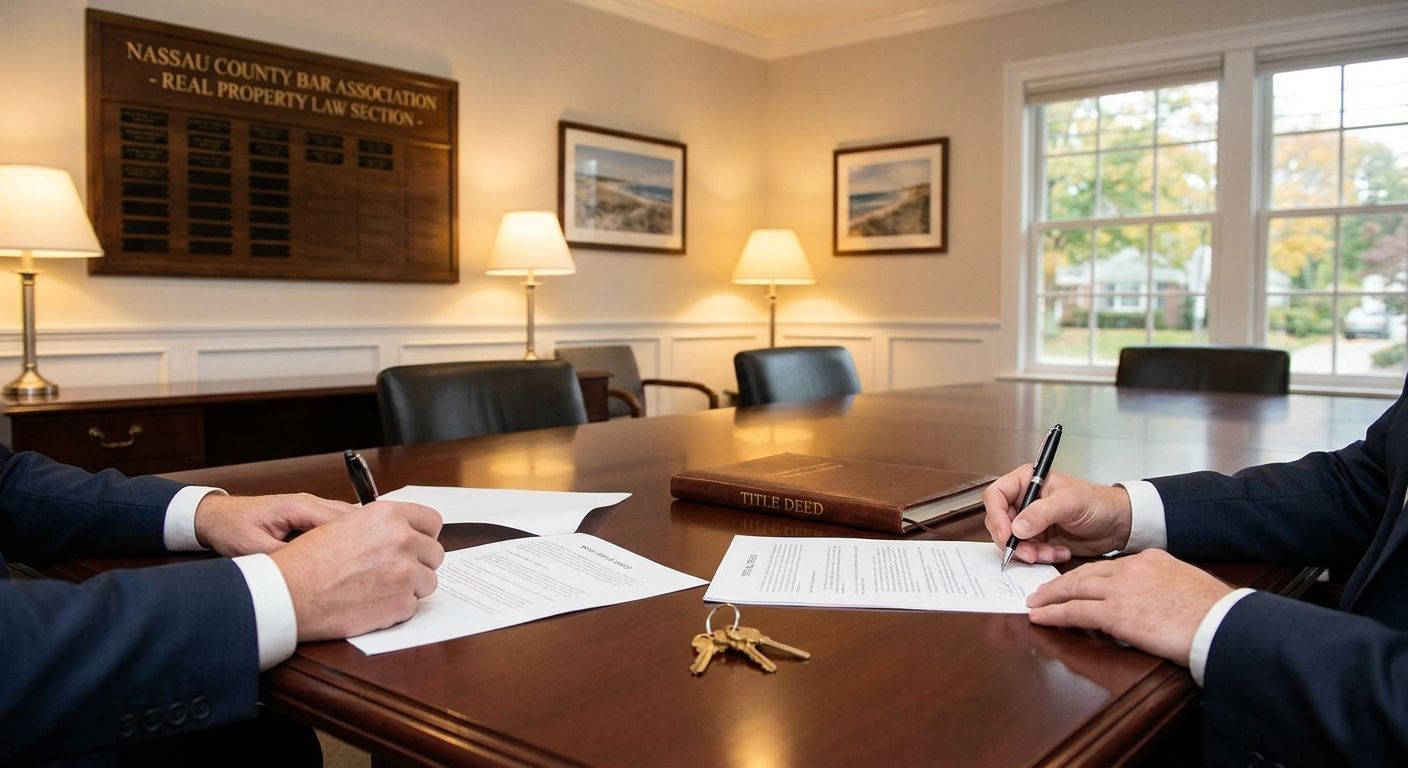
What to Look for in a Long Island Real Estate Closing: A Lawyer's Checklist
A successful Long Island real estate closing requires careful attention to the contract of sale, title search and clearance, mortgage commitment timing, certificate of occupancy compliance, transfer tax allocation, and final walk-through verification. New York is an "attorney state," meaning a licensed New York attorney must represent both the buyer and seller through every step of the transaction. The most common closing problems on Long Island — title defects, mortgage contingency disputes, undisclosed property conditions, and failed inspections — can almost always be prevented when an experienced real estate attorney reviews the contract before signing and stays involved through closing day.
Key Takeaways
- New York is an 'attorney state' — by near-universal custom, a licensed New York attorney represents the buyer, another represents the seller, and an attorney conducts the closing.
- The contract of sale is the single most important document — once signed, the leverage to negotiate changes drops sharply.
- Title defects (liens, judgments, easements, missing deeds) are far more common than buyers expect — and far easier to fix before closing than after.
- The mortgage contingency clause is a critical buyer protection that requires precise wording and strict deadline tracking.
- Long Island closings have unique local considerations: certificate of occupancy compliance, smoke/CO detector requirements, and Suffolk and Nassau County transfer taxes.
- Most "closing nightmares" can be prevented entirely by getting an attorney involved BEFORE the contract is signed — not after.
Why Long Island Real Estate Closings Are Different
New York is an 'attorney state' — by near-universal custom, a licensed New York attorney represents the buyer, another represents the seller, and an attorney conducts the closing. This requirement isn't paperwork — it's the foundation of how property changes hands in Nassau and Suffolk County.
The reason this matters: real estate transactions involve significantly more legal risk than most buyers and sellers realize. Title can be defective. Contracts can be one-sided. Lenders can impose last-minute conditions. The municipality can flag unpermitted work. Every one of these issues either gets caught early by an experienced real estate attorney — or becomes a crisis on or after closing day.
In 27 years of handling Long Island real estate closings, I have seen the same patterns over and over. The deals that go smoothly are the ones where an attorney is engaged BEFORE the contract is signed. The deals that turn into emergencies are the ones where someone tried to save legal fees by shortcutting the early stages.
The Real Estate Closing Process Step by Step
Here is what a properly handled Long Island residential real estate closing looks like, from offer to deed:
1. Offer Acceptance and Contract Negotiation
Once an offer is accepted, the seller's attorney drafts a contract of sale. This is the single most important document in the transaction. Once it's signed, the leverage to negotiate changes drops sharply — which is why the contract should be reviewed by your attorney before you sign anything, not after.
Critical contract items to review:
- Purchase price and deposit terms (typically 10% down at contract signing)
- Mortgage contingency — the clause allowing buyers to cancel and recover the deposit if financing falls through
- Inspection contingency — usually a short window (5-10 business days) to complete inspections
- Title contingency — protects the buyer if title problems are discovered
- Closing date — typically 60-90 days from contract
- Possession terms — when the buyer gets the keys
- What conveys with the property (appliances, fixtures, personal property)
- Smoke and carbon monoxide detector compliance (required by New York law)
- Certificate of occupancy representations
2. Mortgage Application and Commitment
Once the contract is signed, the buyer applies for the mortgage with the lender. The mortgage commitment is the lender's binding promise to fund the loan, subject to specified conditions. Most contracts require the commitment within 30-60 days.
Critical issues to watch:
- The commitment may be conditional. Read it carefully — last-minute conditions like additional appraisals, gift letter requirements, or income re-verification can derail closing.
- The contingency deadline must be tracked. Missing it — even by a day — without an extension can mean losing your deposit if the loan later falls through.
- Rate locks expire. A delayed closing can mean a higher interest rate.
3. Title Search and Title Clearance
Your attorney orders a title report from a title insurance company. The report identifies anything in the public records that affects ownership of the property — including:
- Outstanding mortgages and liens (some of which the seller may not even know about)
- Judgments against prior owners that survived as encumbrances
- Tax liens and unpaid water/sewer charges
- Easements and rights-of-way (utility, neighbor access, conservation)
- Boundary discrepancies and survey issues
- Restrictive covenants that limit how the property can be used
- Missing deeds or breaks in the chain of title
Title defects are far more common than buyers expect — and far easier to clear before closing than after. An experienced Long Island real estate attorney handles title clearance by negotiating payoffs, obtaining lien releases, securing affidavits, and in some cases pursuing quiet title litigation.
4. Inspections and Negotiation of Repairs
The buyer typically has a short contingency window (often 5-10 business days) to complete a home inspection, well water testing (for Suffolk County properties not on public water), oil tank inspections, and any specialized inspections (radon, lead paint, mold, termite). Issues discovered during inspection can lead to renegotiation of the price, seller-funded repairs, or in extreme cases termination of the contract.
5. Certificate of Occupancy and Permit Compliance
This is one of the most underestimated issues in Long Island real estate. Many homes have unpermitted work — finished basements, decks, dormers, additions, or pool installations that were never properly inspected or signed off by the town building department. At closing, this can:
- Hold up the title insurance
- Trigger lender refusal to close
- Require the seller to either obtain after-the-fact permits or escrow funds for compliance
- Result in the town requiring removal of unpermitted improvements
Your attorney should verify that the certificate of occupancy matches the property's current condition long before closing day — not the day before.
6. The Mortgage Commitment, Walk-Through, and Closing
In the final week before closing:
- The lender issues the closing disclosure (a federal requirement at least 3 business days before closing) detailing exact closing costs.
- The buyer conducts a final walk-through to confirm the property is in the condition required by contract — appliances working, no new damage, agreed-upon items left or removed.
- Closing funds are wired (cashier's checks are increasingly disfavored due to fraud concerns).
- At closing, all parties — buyer, seller, both attorneys, lender's representative, title company representative — sign the necessary documents. The deed is delivered, mortgage proceeds are disbursed, the closing disclosure is finalized, and the deed is recorded with the county clerk's office (Nassau County Clerk in Mineola; Suffolk County Clerk in Riverhead).
Long Island-Specific Closing Issues
Long Island closings have several local considerations that buyers and sellers from other regions often miss:
Smoke and Carbon Monoxide Detectors
New York law requires functioning smoke detectors and carbon monoxide detectors at closing. Sellers must typically provide an affidavit. Failure can hold up the closing.
Suffolk County Water and Cesspool Issues
Properties in Suffolk County not connected to public water require well water tests. Properties on cesspools or septic systems may face additional compliance requirements, especially for older systems.
Mansion Tax
New York imposes a 1% 'mansion tax' on residential transactions of $1 million or more, paid by the buyer at closing. The additional progressive 'mansion tax' tiers for sales above $2 million apply only to property in a city with a population of one million or more — currently only New York City. On Long Island, the flat 1% rate applies regardless of how high the price goes.
Transfer Taxes
New York State imposes a real estate transfer tax of $2 for every $500 of price (0.4%), customarily paid by the seller. Nassau and Suffolk County do not impose a general county transfer tax on residential sales; the main local exception is the 2% Peconic Bay Community Preservation Fund tax in the five East End towns of Suffolk County. Any allocation between buyer and seller should be addressed in the contract, not improvised at closing.
Co-op vs Condo vs Single-Family
Co-op closings on Long Island involve additional steps including board approval and proprietary lease assignment. Condo closings involve right-of-first-refusal waivers. Single-family closings are simpler but still benefit from full attorney representation.
Common Mistakes Long Island Buyers and Sellers Make
In 27 years of practice, the same mistakes keep appearing:
- Signing a contract before consulting an attorney. Once signed, your leverage drops sharply.
- Treating the mortgage contingency casually. Missing the deadline by even one day, without a written extension, can result in losing the deposit.
- Skipping the title search or accepting "no exceptions" without reading them. Every line of the title report matters.
- Ignoring certificate of occupancy issues. Unpermitted work catches up at closing.
- Wiring closing funds without verbal verification. Wire fraud in real estate has cost Long Island buyers millions in recent years. Always verbally verify wiring instructions with your attorney by phone before sending money.
- Treating a "for sale by owner" transaction as simple. FSBO transactions still require legal representation — the absence of a real estate broker doesn't simplify the legal complexity.
How an Experienced Long Island Real Estate Attorney Protects You
A real estate closing is one of the largest financial transactions most people ever complete. The legal fees for proper attorney representation are a small fraction of the transaction value — and a fraction of what fixing a botched closing costs.
I have spent 27 years handling Long Island real estate closings — thousands of them, across Nassau and Suffolk County — for buyers, sellers, builders, investors, and commercial clients. I review contracts before they're signed. I negotiate terms that protect my clients. I clear title defects before they become emergencies. I attend the closing personally. And critically: clients work directly with me, not a paralegal team.
If you're buying or selling property on Long Island, call my office for a free consultation. The earlier we talk, the more I can do to protect you.
Buying or Selling Property on Long Island? Get the Legal Protection You Deserve.
Schedule a free consultation with Thomas A. Sirianni, Esq. — 27 years of Long Island real estate experience. Thousands of closings completed across Nassau and Suffolk County.
📞 Call (516) 314-1343
📧 Email tommysirianni@aol.com
Free consultations. Direct attorney access — you work with Tom personally.
Attorney Advertising. Prior results do not guarantee a similar outcome. The information provided in this article is for general informational purposes only and does not constitute legal advice. Reading or interacting with this content does not create an attorney-client relationship. Every real estate transaction is fact-specific. An attorney-client relationship is formed only by a written agreement signed by both Thomas A. Sirianni, Esq. and the client.
More Common Questions
Do I need an attorney for a real estate closing on Long Island?
In New York, an attorney is effectively required for real estate transactions. Unlike many other states where title companies handle closings, New York operates as an "attorney state" — meaning a licensed New York attorney typically represents the buyer, another represents the seller, and an attorney conducts the closing. A Long Island real estate attorney reviews the contract of sale, performs title review, coordinates with the lender, prepares closing documents, and represents your interests at the closing table anywhere from Garden City to Huntington, across both Nassau and Suffolk County. Attempting to close a real estate transaction without an attorney exposes both buyers and sellers to significant legal and financial risk.
What are the typical attorney fees for a Long Island real estate closing?
Attorney fees for residential real estate closings on Long Island vary based on the complexity of the transaction, the property type, and the attorney's experience. Most experienced Long Island real estate attorneys charge a flat fee for standard residential closings, with additional charges for unusual issues such as title defects, complex financing structures, commercial transactions, or contested closings. Fees should be discussed and disclosed in writing before representation begins. A free consultation is the right place to ask about fees for your specific situation.
What is a title defect and how is it resolved?
A title defect is any issue that clouds clear ownership of a property — common examples include unresolved liens, judgments against prior owners, undisclosed easements, missing deeds, boundary disputes, or errors in recorded documents. Title defects are typically discovered during the title search performed before closing. Resolving them may require negotiating payoffs of old liens, obtaining quiet title judgments, securing affidavits, recording corrective deeds, or in some cases litigating to clear the title. An experienced Long Island real estate attorney can identify defects early, advise on the best path to resolution, and prevent a defective closing that creates problems years down the road.
What's the difference between a residential and a commercial real estate closing?
Residential closings involve homes and small multi-family properties (typically 1-4 units) and follow relatively standardized procedures. Commercial closings — for office buildings, retail spaces, mixed-use properties, larger multi-family buildings, and industrial properties — are significantly more complex. Commercial transactions involve detailed contract negotiation, due diligence on tenant leases and property condition, environmental assessments, complex financing structures, entity formation, and substantial lender requirements. Commercial closings on Long Island typically require an attorney with specific experience in commercial real estate matters.
What should I look for when reviewing a Long Island real estate contract?
A Long Island real estate contract should clearly identify the parties, describe the property accurately, specify the purchase price and deposit, set realistic contingency periods (mortgage, inspection, title), and address what happens if any contingency fails. Contracts should also address closing costs, transfer taxes, smoke and carbon monoxide detector requirements, certificate of occupancy issues, mortgage commitment dates, and the closing date. Critical items often missed include possession terms, what personal property conveys with the home, and how disputes will be resolved. A real estate attorney's review can catch issues that protect you from costly surprises before, during, or after closing.
What is a mortgage contingency and why does it matter?
A mortgage contingency is a clause in your real estate contract that allows the buyer to cancel the deal — and recover the deposit — if they cannot obtain a mortgage commitment by a specified date. The contingency typically requires the buyer to apply for financing within a set number of days, work in good faith with the lender, and notify the seller in writing if the contingency is not met. Mortgage contingency periods are commonly 30-60 days from contract signing. Missing the contingency deadline without an extension can mean losing your deposit if financing later falls through. A real estate attorney ensures the contingency is properly worded and that all deadlines are met or extended in writing.
Thomas A. Sirianni, Esq.
Long Island Attorney · 27 Years Experience
- Admitted to the New York State Bar (1999)
- Juris Doctor, Touro Law Center (Jacob D. Fuchsberg Law Center), 1998
- Practicing in Nassau County Supreme Court, Suffolk County Supreme Court, Nassau District Court, and Suffolk District Court