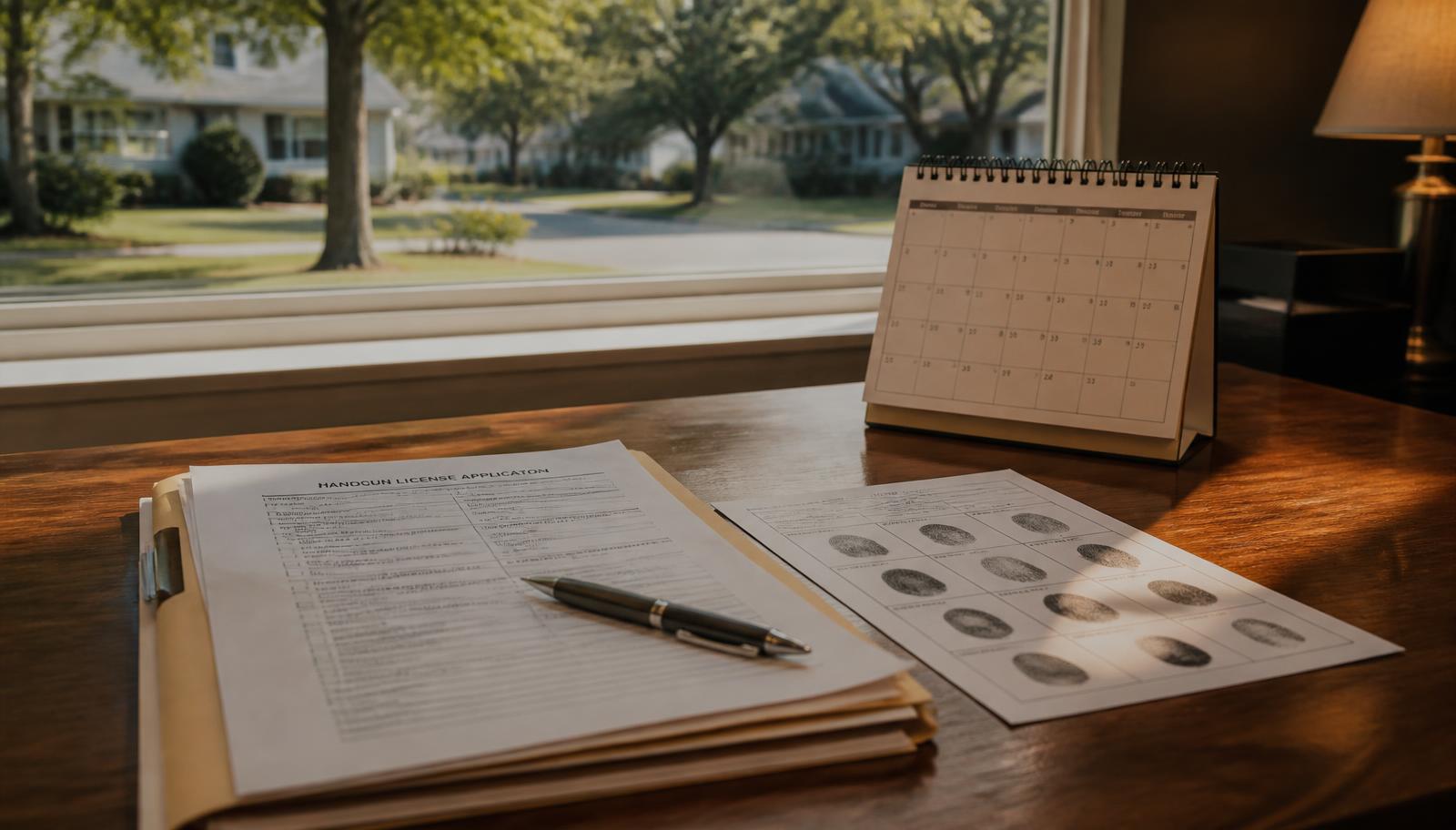
How Long Does It Take to Get a Pistol Permit on Long Island? The Real Nassau and Suffolk County Timeline (2026)
On Long Island, getting a pistol permit usually takes 6 to 12 months in Nassau County and 12 to 18 months or longer in Suffolk County, measured from the day you file the application to the day the license is issued. New York Penal Law 400.00 tells the licensing officer to act within six months, but that deadline has an exception for good cause and it is routinely blown. The wait is driven by fingerprinting and background checks, the in-person interview, character reference verification, and the sheer volume of applications both county police departments are processing since the 2022 Bruen decision opened concealed carry to ordinary applicants.
Key Takeaways
- Handguns in New York require a license before you can even possess one at home. There is no buy-it-while-you-wait option, and the process runs through NY Penal Law 400.00.
- On Long Island the licensing officer is the county police commissioner: the Nassau County Police Department Pistol License Section handles Nassau, and the Suffolk County Police Department Licensing Bureau handles Suffolk. In much of upstate New York it is a judge, which is one reason timelines vary so much across the state.
- The statute directs the licensing officer to act on an application within six months, but it allows written notice of delay for good cause, and in my experience both counties regularly take longer than six months.
- Since the Concealed Carry Improvement Act took effect in September 2022, concealed carry applicants must complete 18 hours of training (16 hours of classroom instruction plus 2 hours of live fire), provide four character references, and sit for an in-person interview.
- A denial is not the end. New York gives you the right to challenge a permit denial in court through a CPLR Article 78 proceeding, but the clock on that challenge is short, generally four months from the final determination.
- Budget realistically. Between county fees, fingerprinting, and the required training course, most of my clients spend roughly $500 to $1,000 before they ever buy the handgun itself.
How long does it take to get a pistol permit on Long Island?
On Long Island, a pistol permit typically takes 6 to 12 months in Nassau County and 12 to 18 months or longer in Suffolk County, from filing to issuance. The six month deadline in Penal Law 400.00 is a direction to the licensing officer, not a guarantee to you, and application volume since the Supreme Court's 2022 decision in NYSRPA v. Bruen has stretched both counties well past it in many cases.
In my practice on Long Island, I tell every applicant the same thing at the first meeting: the calendar is your biggest opponent, not the paperwork. The application itself is manageable. What eats the time is everything that happens after you file: fingerprint processing through the state and FBI, verification of your four character references, the scheduling backlog for your in-person interview, and the final review and sign-off. Any hiccup, a reference who does not return the form, an old arrest that needs explaining, an incomplete training certificate, can add months on its own.
The hard truth is that there is no express lane. No one can lawfully pay to jump the queue, and any service promising to cut a Long Island permit wait to a few weeks is selling something that does not exist. What you can control is filing a complete, accurate, well-documented application the first time, because the single biggest self-inflicted delay I see is an application that bounces back for corrections or gets flagged for something the applicant should have disclosed and explained up front.
What are the steps to apply for a pistol permit in Nassau or Suffolk County?
The sequence is the same in both counties even though the forms and fees differ.
1. Complete the required training first. Concealed carry applicants must finish the 18 hour course (16 hours classroom, 2 hours live fire) before the application will be accepted. Certificates come from state-approved instructors, and this is the one step you can knock out immediately.
2. Gather your documents. Proof of identity and residence, the completed application, four character references from people who are not relatives, employment information, and disclosure of any arrest history anywhere, ever, including sealed and dismissed matters. When in doubt, disclose and explain.
3. File with the correct licensing bureau. Nassau residents file with the Nassau County Police Department Pistol License Section in Mineola. Suffolk residents file with the Suffolk County Police Department Licensing Bureau in Yaphank. Filing in the wrong county starts you over.
4. Get fingerprinted. Prints go to the New York State Division of Criminal Justice Services and the FBI for the background check. This stage runs in the background but any hit on the record triggers manual review and adds time.
5. Sit for the in-person interview. An investigator reviews your application, your history, and your reasons, and assesses the statutory good moral character standard. Treat it like testimony: calm, complete, honest.
6. Wait for reference verification and final review. Your references will be contacted. Tell them to respond promptly, because a silent reference stalls the file.
7. Receive the determination. If approved, you complete issuance and can then purchase a handgun and have it added to the license. If denied, the clock on your court challenge starts running, which I cover below.
Is there a legal deadline for New York to decide a pistol permit application?
Yes, on paper. New York Penal Law 400.00 directs the licensing officer to act on a pistol permit application within six months of filing. But the same statute lets the licensing officer extend that period by giving written notice that there is good cause for the delay, and on Long Island the six month mark comes and goes in a large share of applications without a decision.
What can you do about a stalled application? First, the practical step: a respectful written status inquiry to the licensing bureau, documenting the date you filed. Files do sit, and a paper trail matters. Second, the legal step: when a delay stretches far beyond the statute with no decision and no good cause, an applicant can ask a court to compel a decision through an Article 78 proceeding in the nature of mandamus. That is a real tool, but it is a tool you use deliberately, because you are asking a judge to order the same agency that is evaluating your character to do its job faster. In my experience the inquiry letter resolves more stalls than litigation does, and litigation is there for the cases that truly sit for years.
How much does a pistol permit cost on Long Island?
Most Long Island applicants spend roughly $500 to $1,000 all-in before buying the handgun itself. That figure combines the county application fee, state and FBI fingerprint processing fees of roughly $90 to $105, the required 18 hour training course, which private instructors on Long Island typically charge several hundred dollars for, and incidentals like photos and notarization. The county application fee itself differs between Nassau and Suffolk, so confirm the current amount with the licensing bureau when you file.
The takeaway on cost is that the fees are the small part. The real costs of this process are time and accuracy. A rejected or bounced application does not refund your months, and a denial can put you into court. Spend your money on doing it right once: a reputable training provider, complete documentation, and, if your history has anything that needs explaining, an hour with a lawyer before you file rather than after you are denied.
What training does the Concealed Carry Improvement Act require?
Since September 1, 2022, New York's Concealed Carry Improvement Act requires every concealed carry applicant to complete 18 hours of firearms training: 16 hours of in-person classroom instruction on a state-set curriculum and 2 hours of live fire training at a range, both from an approved instructor. You must present the certificates with your application, and renewing carry licensees face training requirements as well.
The course itself covers safe storage under New York law, applicable state and federal gun laws, situational awareness, conflict de-escalation, the sensitive locations rules, and a written test. Practically: book the course early because it is a prerequisite, keep the original certificates, and make sure your instructor is actually on the approved list, because a certificate from an unapproved provider is a bounced application.
The hard truth is that the CCIA also expanded what the licensing officer reviews. Expect to disclose the adults you live with and expect a searching character review. The statute's good moral character standard survived the post-Bruen court challenges, and the licensing bureaus apply it seriously. Parts of the CCIA have been to federal court and back, and some pieces, like the requirement to disclose your social media accounts, have been blocked by federal courts, so what the application demands can shift. That is a moving area of law, and it is worth confirming the current requirements when you file.
What can get a Long Island pistol permit application denied?
New York law disqualifies applicants outright for certain history: felony convictions, certain serious offenses defined in the Penal Law, involuntary mental health commitments, dishonorable discharge, and being under an order of protection with a firearms restriction, among others. You must also be at least 21. Beyond the hard disqualifiers, the licensing officer applies the good moral character standard, which in practice means the whole file gets weighed: arrests that never led to conviction, old domestic incident reports, DWI history, protective orders that have long expired, even a pattern of bad references or omissions on the application itself.
The denial I see most often on Long Island is not the record itself, it is the failure to disclose the record. The background check will find the 1998 arrest that was dismissed. If your application said no when the answer was yes, the issue is no longer the arrest, it is your honesty, and honesty is exactly what the good moral character standard measures. Disclose everything and attach a short, factual explanation. An old mistake explained is a speed bump. An old mistake concealed is a denial.
What happens if your pistol permit is denied in New York?
A New York pistol permit denial is challenged in court through a CPLR Article 78 proceeding, which asks a judge to review whether the licensing officer's decision was arbitrary and capricious or an abuse of discretion. The deadline is short: generally four months from the final determination. There is no informal do-over built into the statute, so the denial letter itself starts the clock.
The court reviews the record the licensing officer had, so the fight is usually won or lost on the strength of the original application and any response you made to the concerns raised. Deference to the licensing officer is real, but it is not unlimited, and denials that rest on stale, minor, or mischaracterized history do get annulled.
Sometimes the better move than immediate litigation is fixing the underlying problem, a certificate of relief from disabilities for an old conviction, updated documentation, letters addressing the specific concern, and reapplying on a cleaner record. Which path makes sense depends entirely on what the denial letter actually says, which is why the first thing I do for a denied applicant is get the complete reason in writing. You can read more about our Long Island gun protection work here.
Do you need a permit just to keep a handgun at home on Long Island?
Yes. In New York, possessing a handgun anywhere, including inside your own home, requires a license under Penal Law 400.00, and unlicensed possession is a crime under Penal Law Article 265. This is different from most states, and it surprises people who move to Long Island from elsewhere. Rifles and shotguns do not require a license in Nassau or Suffolk County, unlike New York City, but since September 2022 you need a semiautomatic rifle license to buy or take possession of a semiautomatic rifle.
The license categories matter. A premises license lets you keep the handgun at home or at your business. A concealed carry license, which is what most applicants seek after Bruen, lets you carry outside the home subject to New York's long list of sensitive locations where carry remains prohibited, including schools, government buildings, houses of worship, public transit, and Times Square, among others. Getting the license is the beginning of compliance, not the end of it, and the sensitive location rules are where licensed, well-meaning gun owners on Long Island most often get into criminal trouble. That is exactly the situation my gun protection plans exist for.
Thomas A. Sirianni, Esq.
1 Pine Valley Road, Upper Brookville, NY (Nassau County)
(516) 314-1343
thomassirianniesq.com
Frequently Asked Questions
How long does a pistol permit take in Nassau County in 2026?
In my experience, most Nassau County pistol permit applications take 6 to 12 months from filing to issuance through the Nassau County Police Department Pistol License Section. Incomplete applications, slow character references, and anything on your record that requires manual review can push a Nassau application past a year.
How long does a pistol permit take in Suffolk County in 2026?
Suffolk County is generally the slower of the two Long Island counties. Most applications through the Suffolk County Police Department Licensing Bureau take 12 to 18 months, and waits beyond that are not rare. The six month deadline in Penal Law 400.00 has a good cause exception that Suffolk relies on heavily.
Can I buy a handgun while my New York pistol permit is pending?
No. In New York you must have the license before you may lawfully possess a handgun, and the handgun you buy is registered to your license. Possessing a handgun without a license is a crime under Penal Law Article 265, even in your own home, and even if your application is pending and eventually approved.
How often do I have to renew or recertify a New York pistol permit?
Under the Concealed Carry Improvement Act, concealed carry licenses must be recertified every three years, and other license types recertify every five years. Missing recertification can invalidate the license and expose you to seizure of your firearms, so calendar the deadline the day you are issued.
Can I carry in New York with an out-of-state permit?
No. New York does not recognize any other state's carry permit. A Florida or Utah permit means nothing here, and carrying on it is a felony-level risk. If you live on Long Island, the only path is a New York license issued by your county. Part-time residents with a genuine domicile connection should get specific legal advice before assuming they qualify.
Do I need a permit for a rifle or shotgun on Long Island?
Ordinary rifles and shotguns do not require a license in Nassau or Suffolk County, unlike New York City. However, since September 2022 New York requires a semiautomatic rifle license to purchase or take possession of a semiautomatic rifle, and that license runs through the same county licensing process as a pistol permit.
What disqualifies you from a pistol permit in New York?
Felony convictions, certain serious offenses, involuntary mental health commitments, dishonorable discharge from the military, active orders of protection with firearms restrictions, and being under 21 are among the disqualifiers under Penal Law 400.00. Beyond those, the licensing officer applies a good moral character review of your full history, and material omissions on the application are themselves a common reason for denial.
Permit stalled, denied, or seized? Call for a free consultation.
Nassau and Suffolk County gun owners: I will review where your application actually stands, whether the delay or denial can be challenged, and what your realistic options are, at no cost for the initial consultation. I also offer prepaid gun protection plans so that if you ever have to use or defend your legally owned firearm, your lawyer is already retained. I answer my own phone, 7 days a week, 6:00 AM to 8:00 PM.
Attorney advertising. This article is general information about New York law only, not legal advice, and does not create an attorney-client relationship. Statutes and court rules change and deadlines vary by case; consult a licensed New York attorney about your specific situation promptly. Prior results do not guarantee a similar outcome.