What Disqualifies You From Getting a Pistol Permit in New York? The 9 Automatic Disqualifiers, the Good Moral Character Trap, and What Long Island Applicants Can Fix Before Applying (2026)
In New York, nine things automatically disqualify you from a pistol permit under Penal Law 400.00(1): being under 21 (unless honorably discharged from the military), a felony or "serious offense" conviction anywhere, an outstanding felony or serious offense warrant, being a fugitive, unlawful drug use or addiction, a dishonorable discharge, renounced citizenship, an involuntary psychiatric commitment or a Mental Hygiene Law 9.46 report, and a prior license revocation or a suspension order tied to an order of protection. For a concealed carry license there are two more: a conviction within five years for assault in the third degree, misdemeanor DWI, or menacing, and failure to complete the 16 hour classroom and 2 hour live fire course. On top of all of that sits the "good moral character" standard, which is discretionary, and in my experience it is where most Long Island denials actually come from.
Key Takeaways
- Penal Law 400.00(1) lists the hard disqualifiers, lettered (a) through (o). Nine of them apply to every license. Two more, the five year lookback for assault, DWI, and menacing, and the training certificate, apply only to a concealed carry license.
- "Serious offense" is defined in Penal Law 265.00(17), and it reaches misdemeanors most people never think of as serious: endangering the welfare of a child, forcible touching, seventh degree drug possession, fourth degree stalking, and any misdemeanor committed against a family or household member such as third degree assault, second degree menacing, or second degree criminal contempt.
- A misdemeanor DWI is not a lifetime bar. It blocks a concealed carry license only if the conviction is within five years of the application date, and it does not appear on the list at all for a premises license, though the licensing officer can still weigh it.
- Under Penal Law 400.00(4-b), the licensing officer must act on your application within six months unless they send you written notice stating the specific reason for the delay.
- The social media disclosure clause in Penal Law 400.00(1)(o)(iv) is still printed in the statute, but the Second Circuit held it unconstitutional in Antonyuk v. James in October 2024 and the Supreme Court declined review on April 7, 2025, so it is not enforceable.
- A false or incomplete answer on the application is worse than the thing you were hiding. Penal Law 400.00(11)(a) requires the licensing officer to revoke a license obtained with a knowingly false material statement, and the lie follows you to every future application.
What disqualifies you from getting a pistol permit in New York?
Nine things automatically disqualify you from a New York pistol permit: being under 21 without an honorable discharge, a felony or serious offense conviction anywhere, an open felony or serious offense warrant, fugitive status, unlawful drug use or addiction, a dishonorable discharge, renounced U.S. citizenship, an involuntary psychiatric commitment or a Mental Hygiene Law 9.46 report, and a prior revocation or an active suspension order under Criminal Procedure Law 530.14 or Family Court Act 842-a. Every one of them comes straight from Penal Law 400.00(1).
Those are the bright lines. If one of them applies to you, the licensing officer has no discretion to issue the license, and no amount of character letters changes that. What people on Long Island usually get wrong is the direction of the mistake. They assume a 15 year old misdemeanor is an automatic bar when it often is not, and they assume a messy divorce with a temporary order of protection is nothing when it can be everything. The statute is specific, and the details decide the case.
The hard truth is that the list above is the easy part of the analysis. The harder part is paragraph (b), good moral character, which the statute defines as having the essential character, temperament, and judgment necessary to be entrusted with a weapon and to use it only in a manner that does not endanger yourself or others. That is a judgment call made by the Nassau County Police Commissioner, the Suffolk County Sheriff or Police Commissioner depending on your town, or the NYPD License Division if you live in the five boroughs, after a full investigation of your record, your references, and your interview. An applicant with no automatic disqualifier can still be denied on character, and that is where my practice spends most of its time. For the timeline side of this process, I cover how long a Nassau or Suffolk application takes in a separate article on how long a pistol permit takes in New York.
What are the eligibility requirements for a pistol permit under Penal Law 400.00?
Penal Law 400.00(1) requires that a license be issued only after an investigation confirms every statement on the application is true, and only to an applicant who is 21 or older, of good moral character, free of any felony or serious offense conviction or warrant, not a fugitive, not an unlawful drug user, lawfully present in the country, not dishonorably discharged, not a renounced citizen, not involuntarily committed, not under a revocation or protective order suspension, and not under a guardianship for incapacity.
The age rule has one exception written into the statute: an applicant honorably discharged from the Army, Navy, Marine Corps, Air Force, Coast Guard, or the New York National Guard can apply before 21. Paragraph (i) is also worth reading carefully, because it does not say an applicant with any mental illness history is barred. It says the applicant must have stated whether he or she has ever suffered any mental illness. The disqualifier is the lie, not the diagnosis. The actual mental health bar is paragraph (j), and it is narrow: an involuntary commitment under Mental Hygiene Law Article 9 or 15, a CPL 730 or 330.20 commitment, civil confinement under Mental Hygiene Law Article 10, or a report under Mental Hygiene Law 9.46, which is the SAFE Act provision that lets a mental health professional report a patient likely to harm themselves or others. Voluntary outpatient counseling and a prescription for an antidepressant are not on that list.
For a concealed carry license, which is the license issued under Penal Law 400.00(2)(f), two more paragraphs apply. Paragraph (n) bars anyone convicted within five years of the application date of assault in the third degree under Penal Law 120.00, misdemeanor DWI under Vehicle and Traffic Law 1192, or menacing under Penal Law 120.15. Paragraph (o) requires an in person interview with the licensing officer and the submission of the names of your spouse or domestic partner and any other adults in your home, no fewer than four character references, the training certificate required by Penal Law 400.00(19), and whatever other information the licensing officer reasonably needs to review the application. The same paragraph lists three years of social media accounts, but as explained below, that clause is not enforceable. Federal law adds its own layer under 18 U.S.C. 922(g), which separately prohibits possession by, among others, anyone convicted of a misdemeanor crime of domestic violence or subject to a qualifying order of protection, and a New York licensing officer cannot license someone federal law prohibits.
What counts as a "serious offense" that bars a New York pistol permit?
A "serious offense" under Penal Law 265.00(17) includes illegally using or possessing a weapon, possession of burglar's tools, third degree criminal possession of stolen property, jostling, fraudulent accosting, endangering the welfare of a child, third degree obscenity, permitting or third degree promoting prostitution, third and fourth degree stalking, sexual misconduct, forcible touching, second and third degree sexual abuse, seventh degree criminal possession of a controlled substance, criminally possessing a hypodermic instrument, second degree criminally using drug paraphernalia, and any hate crime under Penal Law Article 485.
That is paragraph (a) of the definition, and it reaches offenses that most of my clients never thought of as "serious" when they took a plea 20 years ago. The seventh degree drug possession plea from college counts. The endangering the welfare of a child plea that came out of a custody fight counts. Paragraph (b) adds a second list that applies only where the victim was a family or household member as defined in Criminal Procedure Law 530.11: third degree assault, second and third degree menacing, criminal obstruction of breathing, second degree unlawful imprisonment, third degree coercion, third degree criminal tampering, second degree criminal contempt, first degree harassment, second degree aggravated harassment, second and third degree criminal trespass, fifth degree arson, and attempts at any of them. A second degree criminal contempt conviction for violating an order of protection against a spouse is a serious offense. The same conviction for violating a court order in a business dispute is not. Paragraph (c) sweeps in any misdemeanor from another state that has all the elements of a New York felony.
Penal Law 400.00(1-b) closes the out of state loophole in both directions. An offense from any jurisdiction that contains all the essential elements of a listed offense counts as a serious offense. And even when an out of state conviction does not line up element for element, the statute expressly says nothing prevents the licensing officer from denying the license based on it. So a Florida conviction that is not a technical "serious offense" can still sink a Nassau application on character grounds. If you have any conviction anywhere, the first thing I do is pull the certificate of disposition and the statute you were convicted under, not the charge you were arrested for, because the plea you took is what controls.
How does a New York pistol permit application get decided, start to finish?
The process runs through the same stages everywhere in the state, though who sits in the licensing officer's chair changes by county under Penal Law 265.00(10): the Police Commissioner in Nassau, the Sheriff in Suffolk except in Babylon, Brookhaven, Huntington, Islip, and Smithtown where it is the Suffolk Police Commissioner, the NYPD Police Commissioner in the five boroughs, and a county or supreme court judge in most of upstate.
1. Complete the training before you file (weeks 1 to 4, concealed carry only). Penal Law 400.00(19) requires a minimum of 16 hours of in person classroom instruction plus 2 hours of live fire range training, a written test passed at 80 percent, and a certificate signed by the instructor under penalty of perjury. A premises license does not require it.
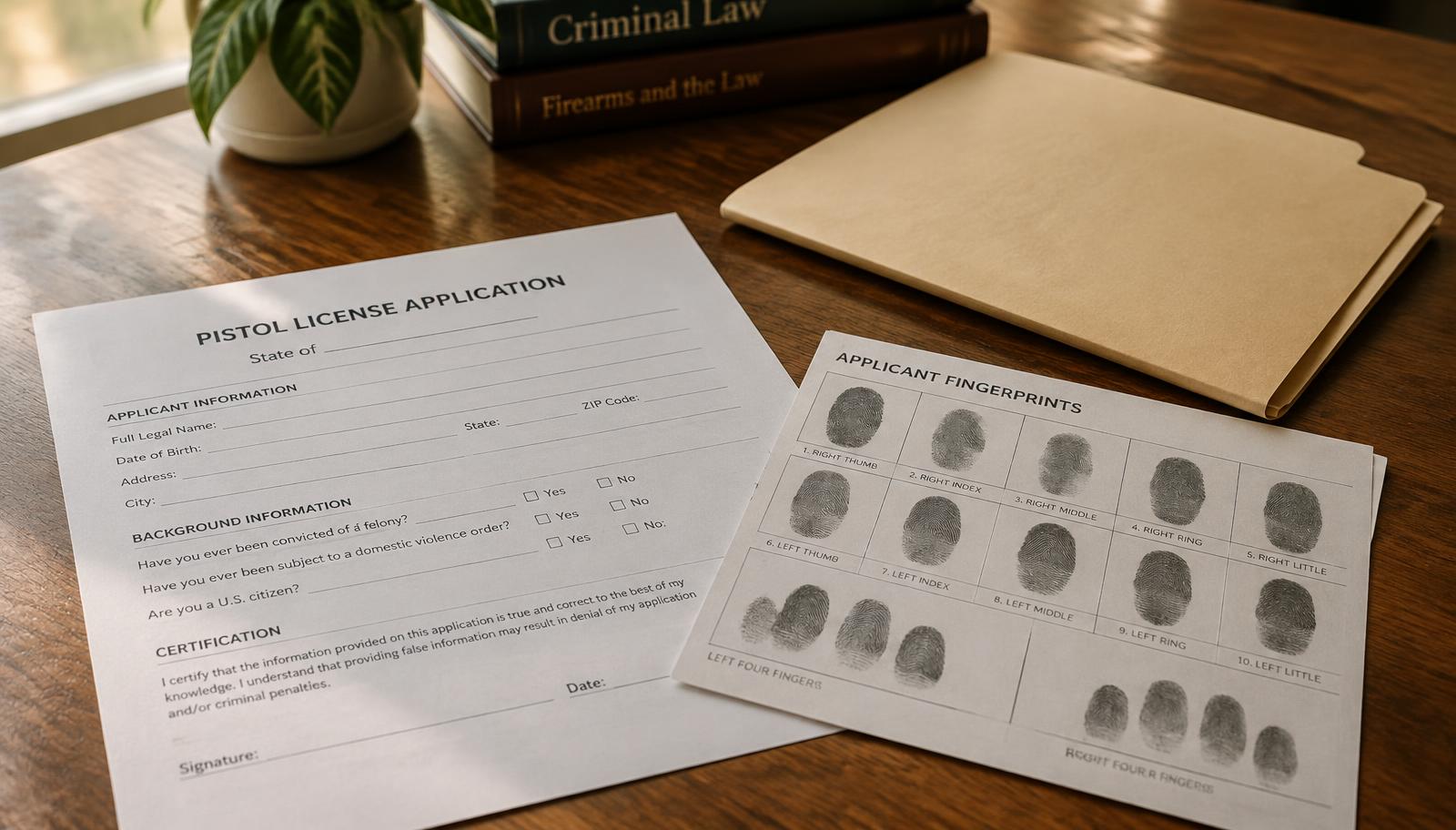
2. File the application with the licensing officer where you live (week 4 to 6). Penal Law 400.00(3) requires you to state your full name, date of birth, residence, occupation, citizenship, and whether you meet each eligibility requirement in subdivision one, signed and verified, with photographs taken within 30 days. This is the document a false statement lives on.
3. Fingerprinting and the criminal history search (week 6 to 10). Penal Law 400.00(4) requires the investigating police authority to take your fingerprints and run them through the Division of Criminal Justice Services and the FBI. There is no application that skips this, and the search returns sealed and out of state records the applicant forgot about.
4. The background investigation and reference checks (month 2 to 5). Under Penal Law 400.00(4), the police authority investigates every statement on the application, including mental hygiene records, and reports to the licensing officer. On Long Island, investigators call your references, your household members, and in many cases your employer.
5. The in person interview (month 3 to 5, concealed carry). Penal Law 400.00(1)(o) requires the applicant to meet in person with the licensing officer. Your answers are compared against your application and the investigator's file. Inconsistencies here are the single most common path to a character denial.
6. The decision (by month 6). Penal Law 400.00(4-b) requires the licensing officer to act within six months of the date you presented the application unless they send you a written notice stating the specific reasons for the delay, and a denial must state the reasons specifically and concisely in writing.
7. If denied, the appeal clock starts (90 days). Penal Law 400.00(4-a) gives you 90 days from receipt of the written denial to request a hearing before the appeals board created by DCJS and the State Police, and the same subdivision entitles you to counsel at that hearing and the right to present additional evidence. Denials are also challenged in court by Article 78 proceeding, which I explain in my article on appealing a pistol permit denial in Nassau and Suffolk.
How much does a New York pistol permit cost?
The license fee itself is set locally, not by the state, for the places most of my clients live. Penal Law 400.00(14) lets New York City, Nassau County, and Westchester County set their own fee for a license to carry or possess a pistol, while elsewhere in the state the statute caps the county fee at between $3 and $10, with an amendment fee of $3, or $5 in Suffolk County. Confirm the current fee with the licensing bureau before you file, since counties change them.
The fee is never the real cost. The real cost of a concealed carry application is the 18 hour training course, which is taught by private instructors who set their own prices, plus the fingerprinting charge, plus your time. In my practice the expense clients underestimate most is what it costs to fix a problem after a denial. An Article 78 proceeding or an appeals board hearing is far more expensive than a one hour consultation before filing, and a denial on the record makes every later application harder because the next licensing officer reads the last one. If you have a conviction, an old arrest, a psychiatric hospitalization, or an order of protection anywhere in your history, the cheapest money you will spend on this process is having a firearms attorney review your file before you sign the application, not after.
One more number matters. Penal Law 400.00(10)(d) requires a concealed carry license to be recertified or renewed every three years, while a premises license in Nassau and Suffolk expires in five years under 400.00(10)(a). Those renewals rerun the eligibility check, so a conviction or protective order that happens after you are licensed will surface then, if it has not already triggered a revocation under 400.00(11).
Can I get a pistol permit in New York with a DWI, an old misdemeanor, or a dismissed arrest?
Often yes, and the statute draws clearer lines than most applicants expect. A misdemeanor DWI under Vehicle and Traffic Law 1192 bars a concealed carry license only if the conviction is within five years of the application under Penal Law 400.00(1)(n). It is not on the automatic list for a premises license at all. A misdemeanor that is not a "serious offense" under Penal Law 265.00(17) is not an automatic bar for any license. A dismissed or sealed arrest is not a conviction and cannot be treated as one.
Now the part people do not want to hear. "Not an automatic bar" is not the same as "irrelevant." Every one of those items goes to the licensing officer under the good moral character standard, and the investigation under Penal Law 400.00(4) will find it whether you disclose it or not. Two DWIs eight years apart tell a story about judgment with alcohol that a licensing officer in Mineola or Yaphank is entitled to weigh. An arrest that was dismissed because the complaining witness stopped cooperating is not a conviction, but the police report describing what happened is in the file the investigator reads. I have reviewed denial letters built almost entirely on dismissed charges, and whether that denial survives review turns on whether the officer articulated specific facts or just recited the arrests. Since Bruen, that distinction matters more than it used to.
The right move with any of this history is to confront it in the application rather than hope it goes unnoticed. Disclose the conviction accurately, attach the certificate of disposition, and where the case is old, show what has changed since: years without incident, steady employment, completion of any program. The applicant who explains a 2012 DWI in two honest paragraphs is in a far stronger position than the applicant whose interviewer brings it up first. What I cannot tell you from an article is how your particular record reads to your particular licensing officer, because that depends on documents I have not seen.
What is "good moral character," and can they deny my pistol permit on it alone?
Yes. Good moral character is an independent requirement under Penal Law 400.00(1)(b), defined as having the essential character, temperament, and judgment necessary to be entrusted with a weapon and to use it only in a manner that does not endanger oneself or others. A licensing officer can deny on that ground even when every automatic disqualifier comes back clean, and the Second Circuit upheld the standard against a facial constitutional challenge in Antonyuk v. James in October 2024.
This is the standard that does most of the work in Nassau and Suffolk. It is where a pattern of police contacts with no convictions ends up, where a contentious divorce with a since expired order of protection ends up, where an untreated drinking problem that never produced a DWI ends up. It is also where the interview ends up. The investigator's write up of what you said, how you said it, and whether it matched your paperwork is evidence of temperament and judgment, which is exactly what the statute asks about.
Two things changed in your favor since 2022. First, Bruen eliminated "proper cause," so no licensing officer may deny a carry license because you failed to show a special need. Second, the Second Circuit in Antonyuk struck the requirement in Penal Law 400.00(1)(o)(iv) that applicants hand over three years of social media account names, finding it an impermissible burden on Second Amendment rights with serious First Amendment problems, and the Supreme Court denied certiorari on April 7, 2025, leaving that ruling in place. The clause is still printed in the statute, so you will still see it on some forms. What the court left intact is the licensing officer's ability to review public social media posts, and investigators on Long Island do exactly that. If your public posts show a temper, threats, or glorification of violence, expect them in the denial letter, because the character standard reaches conduct that was never charged. For the full picture of what the firm handles on the licensing side, see my firearms and Second Amendment practice page.
What mistakes get an otherwise eligible applicant denied?
The most common one is the false or incomplete answer. Penal Law 400.00(3) requires the application to be signed and verified, which means sworn, and Penal Law 400.00(11)(a) requires the licensing officer to revoke any license issued on a knowingly false material statement. An applicant who writes "no" to the arrest question because the case was dismissed, or who leaves off the 1990s misdemeanor because the lawyer said it would "go away," has handed the licensing officer the easiest denial in the book: the investigation finds it, and now the issue is honesty, which goes directly to character. The underlying charge might have been explainable. The omission is not.
After that, in rough order of how often I see them: references who were never told they would be called and gave a lukewarm or surprised answer; household members listed under 400.00(1)(o)(i) who have their own disqualifying history the applicant never considered; a training certificate from a course that did not meet the 16 and 2 hour curriculum in 400.00(19); an applicant who moved and applied in the wrong county, since 400.00(3)(a) requires filing where you reside or are principally employed; and the interview answer that contradicts the application on something small, like dates of employment or a prior address, which reads as evasion even when it was a memory lapse.
The hard truth after 27 years of these files is that New York licensing officers deny on judgment, not just on records, and your application is the first and biggest piece of evidence about your judgment. Treat it like a sworn statement, because it is one. If anything in your history gives you pause, the time to get an attorney's eyes on it is before the fingerprint appointment, not after the denial letter, because a denial on the record follows you, and under Penal Law 400.00(4-a) the appeal window is 90 days from the day you receive it.
Thomas A. Sirianni, Esq.
1 Pine Valley Road, Upper Brookville, NY (Nassau County)
(516) 314-1343
thomassirianniesq.com
Frequently Asked Questions
What disqualifies you from getting a pistol permit in New York?
Penal Law 400.00(1) automatically disqualifies anyone under 21 without an honorable discharge, anyone convicted anywhere of a felony or a "serious offense" as defined in Penal Law 265.00(17), fugitives and people with open felony or serious offense warrants, unlawful drug users, people dishonorably discharged or who renounced citizenship, anyone involuntarily committed or reported under Mental Hygiene Law 9.46, and anyone with a prior revocation or a suspension order tied to an order of protection. For a concealed carry license, a conviction within five years for third degree assault, misdemeanor DWI, or menacing also bars the license, and the licensing officer can separately deny on good moral character.
Can you get a pistol permit in New York with a misdemeanor?
Often yes. A misdemeanor bars a New York pistol permit automatically only if it is a "serious offense" under Penal Law 265.00(17), or, for a concealed carry license, if it is third degree assault, misdemeanor DWI, or menacing within five years of the application under Penal Law 400.00(1)(n). Any other misdemeanor is not an automatic bar, but the licensing officer can still weigh it under the good moral character standard.
Can you get a pistol permit in New York with a DWI?
A misdemeanor DWI under Vehicle and Traffic Law 1192 bars a concealed carry license only when the conviction is within five years of the application date under Penal Law 400.00(1)(n). Outside that window, and for a premises license at any time, it is not an automatic disqualifier, though a licensing officer in Nassau, Suffolk, or New York City can consider it as evidence of judgment under the good moral character requirement.
Does a mental health history disqualify you from a pistol permit in New York?
Not by itself. Penal Law 400.00(1)(j) bars an applicant who was involuntarily committed under Mental Hygiene Law Article 9 or 15, committed under CPL 730 or 330.20, civilly confined under Mental Hygiene Law Article 10, or the subject of a Mental Hygiene Law 9.46 report. Voluntary therapy or medication is not on that list, but Penal Law 400.00(1)(i) requires you to truthfully state whether you have ever suffered any mental illness, and a false answer is itself grounds for denial and revocation.
Does an order of protection disqualify you from a pistol permit in New York?
An active suspension or ineligibility order issued under Criminal Procedure Law 530.14 or Family Court Act 842-a is an automatic bar under Penal Law 400.00(1)(k), and federal law under 18 U.S.C. 922(g)(8) separately prohibits possession while certain protective orders are in effect. An expired order is not an automatic disqualifier, but the conduct behind it, and any criminal contempt conviction for violating it, will be weighed under the good moral character standard.
How long does the licensing officer have to decide a pistol permit application in New York?
Six months. Penal Law 400.00(4-b) requires the licensing officer to act on the application within six months of the date it was presented, unless the applicant is sent written notice stating the specific reasons for the delay, and the delay must be for good cause relating to that applicant. A denial must state its reasons specifically and concisely in writing.
Is the social media requirement for a New York pistol permit still in effect?
No. The clause in Penal Law 400.00(1)(o)(iv) requiring concealed carry applicants to list three years of social media accounts was held unconstitutional by the Second Circuit in Antonyuk v. James in October 2024, and the Supreme Court declined to review that decision on April 7, 2025. The text remains in the statute, but it cannot be enforced. Licensing officers may still review an applicant's public posts as part of the character investigation.
Worried something in your past will sink your pistol permit? Call for a free consultation.
Nassau and Suffolk County applicants: I will pull your record, read the actual dispositions, and tell you honestly whether you have an automatic disqualifier, a character problem that can be addressed, or a clean file that just needs to be presented correctly, before you sign a sworn application. If you have already been denied, bring the letter, because the 90 day appeal clock is running. I answer my own phone, 7 days a week, 6:00 AM to 8:00 PM.
Attorney advertising. This article is general information about New York law only, not legal advice, and does not create an attorney-client relationship. Statutes and court rules change and deadlines vary by case; consult a licensed New York attorney about your specific situation promptly. Prior results do not guarantee a similar outcome.