How Do You Evict Someone Without a Lease in New York? The Notice, Timeline, and Cost for Month to Month Tenants, Family Members, Roommates, and Squatters on Long Island (2026)
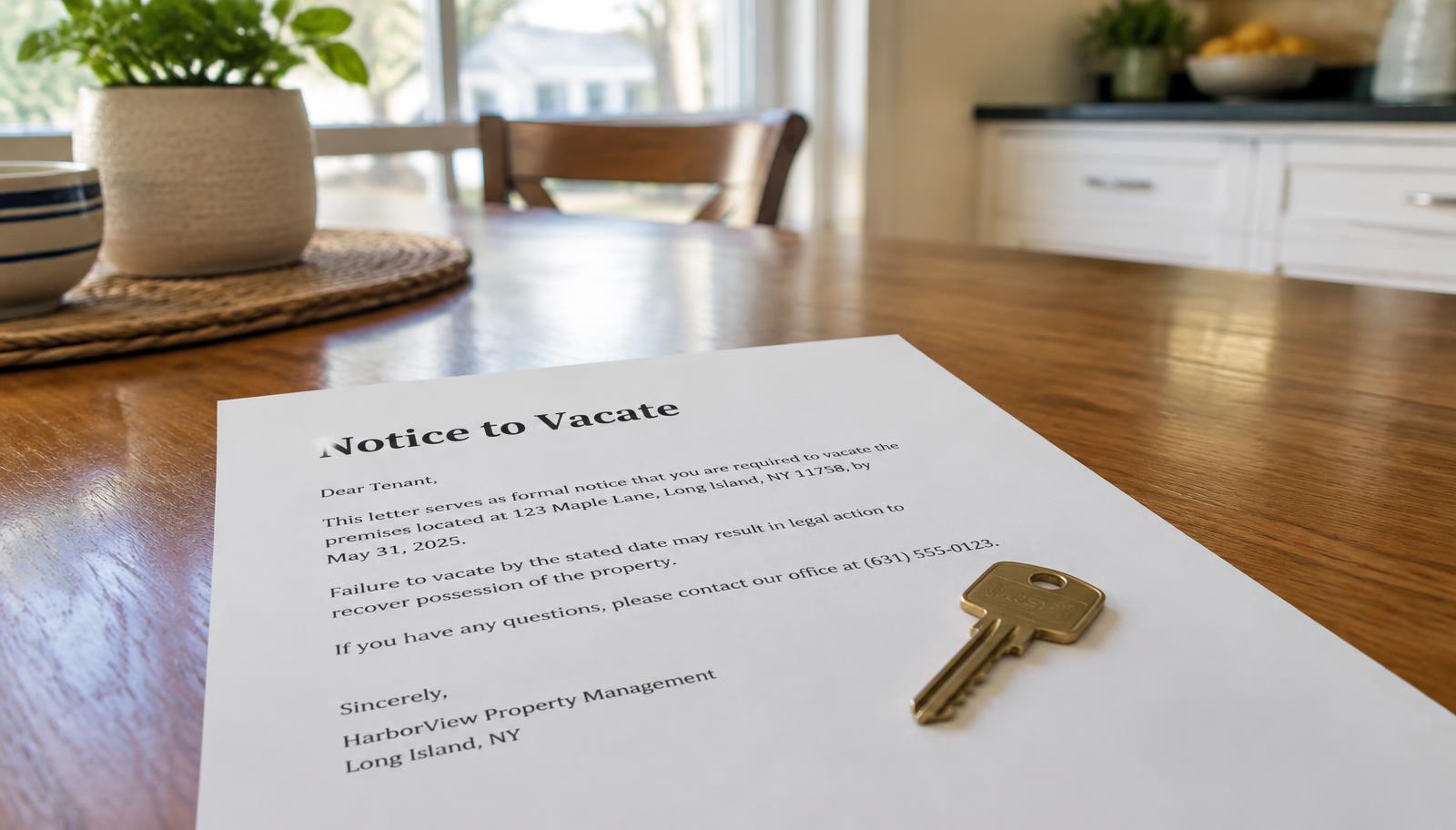
In New York, you evict someone without a lease by serving the correct written notice, filing a holdover proceeding in the local court after the notice expires, winning a judgment of possession, and having the sheriff or marshal execute a warrant of eviction after a final 14 day notice. The notice length depends on who the person is: a month to month tenant or anyone who has been paying rent gets 30, 60, or 90 days under RPL 226-c based on how long they have lived there, a licensee such as a guest or relative who was allowed to stay but never paid rent gets a 10 day notice to quit under RPAPL 713(7), and a squatter who entered without permission gets the same 10 day notice under RPAPL 713(3). From the first notice to the lockout, an uncontested case on Long Island usually runs 2 to 4 months, and a contested one 4 to 6 months or more. No lease never means no court. RPAPL 711 says no tenant or lawful occupant may be removed except in a special proceeding.
Key Takeaways
- There is no such thing as an informal eviction in New York. RPAPL 711 requires a court proceeding to remove any tenant or lawful occupant, lease or no lease, and RPAPL 853 lets a person who is forced out recover treble damages.
- The notice is the whole case. A month to month tenant gets 30 days if there less than a year, 60 days if there one to two years, and 90 days if there two years or more under RPL 226-c, measured by cumulative occupancy. A licensee or squatter gets a 10 day notice to quit under RPAPL 713.
- Since 2024, RPAPL 711 says in so many words that a squatter is not a tenant. A person who entered without permission and stayed without permission does not get tenant protections, but still must be removed through RPAPL 713(3), not by force.
- Outside New York City, the old one month rule in RPL 232-b no longer applies to residential landlords. The 30, 60, or 90 day notice under RPL 226-c controls, and in Nassau and Suffolk the case is filed in District Court.
- Accepting a rent payment after a termination notice expires can reinstate the tenancy you just ended. Accepting money from a licensee can convert that licensee into a tenant entitled to the longer notice.
- In my practice, the uncontested no lease case runs about 2 to 4 months and roughly $1,500 to $2,500 in attorney fees plus a few hundred dollars in court and sheriff's costs, and the contested case costs multiples of that mostly in months, not fees.
How do you evict someone without a lease in New York?
You evict someone without a lease in New York the same way you evict someone with one: written notice first, then a holdover proceeding in court, then a judgment and a warrant of eviction executed only by the sheriff, constable, or city marshal. The absence of a lease changes which notice you serve and how long it runs. It does not create a shortcut around the courthouse.
This surprises people every week. A homeowner in Levittown lets a cousin move into the basement for "a few months," no rent, no paperwork, and two years later the cousin will not leave. A landlord in Huntington had a one year lease that ended in 2023, kept taking rent, and now wants the house back. A couple in Bay Shore came home from vacation to a stranger inside claiming he lives there. All three call me asking some version of "there was never a lease, so can I just put their things on the lawn?" The answer to all three is no. RPAPL 711 states that no tenant or lawful occupant of a dwelling shall be removed from possession except in a special proceeding, and the proceeding for people with no landlord-tenant relationship at all, RPAPL 713, still requires a notice and a petition.
What the lack of a lease actually does is sort the occupant into one of three boxes, and the box decides the notice. Someone who has been paying rent, even informally, even in cash, even to a relative, is a month to month tenant and gets 30 to 90 days under RPL 226-c. Someone who was allowed to stay but never paid is a licensee and gets a 10 day notice to quit under RPAPL 713(7). Someone who was never allowed in at all is a squatter and gets a 10 day notice to quit under RPAPL 713(3). Get the box wrong and the court dismisses the case months in, and you start over. The rest of this article walks through each box, the steps, the cost, and the mistakes, and for a lease based nonpayment eviction my article on the New York eviction timeline and cost covers that track.
What notice do I have to give someone with no lease in New York?
For a month to month tenant or anyone paying rent, RPL 226-c requires at least 30 days written notice if the tenant has occupied the unit less than one year, at least 60 days if more than one year but less than two, and at least 90 days if more than two years, measured by the cumulative time the person has lived there. For a licensee or a squatter, RPAPL 713 requires a 10 day notice to quit served in the manner prescribed by RPAPL 735.
The 226-c notice applies whenever a landlord does not intend to renew a tenancy, and a month to month arrangement is treated as renewing every month, so ending it is a non-renewal. Two traps live in that statute. First, the clock is cumulative. A tenant who signed a one year lease in 2022 and has been month to month since then has occupied the unit for more than two years and gets 90 days, not 30. Second, the statute says that if the landlord fails to give timely notice, the tenancy continues under the existing terms from the date actual written notice was given until the full notice period runs. A short notice does not just lose the case. It restarts the calendar from the day you finally serve a proper one.
Landlords who have been doing this a long time remember RPL 232-b, which allowed a one month notice to end a month to month tenancy outside New York City. Since the 2019 amendments, that section applies only to tenants and to non-residential landlords. A residential landlord in Nassau or Suffolk ending a month to month tenancy uses the 30, 60, or 90 day notice in RPL 226-c, full stop. The notice must also append the disclosure required by RPL 231-c stating whether the unit is subject to the Good Cause Eviction Law in RPL Article 6-A and, if exempt, why. That law applies automatically in New York City and only in municipalities that have opted in elsewhere, but the disclosure goes on every notice statewide. I review notices landlords drafted themselves, and the most common defects are the wrong period, the missing 231-c language, and service by taping it to the door with no affidavit, any one of which is a dismissal waiting to happen.
What are the steps to evict someone with no lease in New York, start to finish?
The process runs the same stages whether the occupant is a month to month tenant, a licensee, or a squatter. Only the first notice and its length change.
1. Identify the occupant correctly and serve the right notice (day 1 to 10 for a licensee or squatter; day 1 to 30, 60, or 90 for a tenant). A 10 day notice to quit under RPAPL 713 for a licensee or squatter, or a 30, 60, or 90 day termination notice under RPL 226-c with the RPL 231-c disclosure for anyone who has paid rent. Serve it in the manner RPAPL 735 prescribes, with a sworn affidavit of service, and do not accept a dollar from the occupant after it is served.
2. Wait for the notice to fully expire (through the last day of the period). Nothing may be filed until the period runs. File one day early and the petition is dismissed. For a 226-c notice, count from the date of actual written notice, not the date you decided to end the tenancy.
3. File the holdover petition and notice of petition in the right court (week 2 to 6 after expiration). On Long Island that is the Nassau County District Court or the Suffolk County District Court for the town where the property sits; in the five boroughs it is Housing Court. A holdover against a tenant is brought under RPAPL 711(1). A proceeding against a licensee or squatter is brought under RPAPL 713. The petition must match the notice to the day.
4. Serve the petition and the first court date (week 4 to 8). The occupant can appear and answer, raising defective notice, improper service, a claim that they are really a tenant entitled to longer notice, or, in a squatter case, a claim that they had permission. If they default, you can seek a default judgment, but defaults on sloppy service get vacated later.
5. Appearances, adjournments, and settlement (month 2 to 4). Courts grant time to find counsel. Many no lease cases settle here with a stipulated move out date, which is routinely the fastest realistic path to possession.
6. Judgment of possession and the warrant (month 2 to 5). If you prevail, the court issues a judgment and a warrant of eviction directed under RPAPL 749(1) to the sheriff of the county, or a constable, or a city marshal in a city.
7. The 14 day notice and the lockout (month 3 to 6). RPAPL 749(2)(a) requires the officer to give at least 14 days written notice to the people being removed and to execute the warrant on a business day between sunrise and sunset. Only that officer performs the lockout. You do not.
How much does it cost to evict someone without a lease in New York?
The court costs are modest. Filing the petition, process server fees, and the sheriff's or marshal's fee for the lockout together commonly run a few hundred dollars, and you should confirm current figures with the court clerk and the county sheriff, since they vary by court and change. Attorney fees in my practice for an uncontested no lease holdover typically run from about $1,500 to $2,500, and a contested case, where the occupant claims tenant status or fights service, can run $5,000 or more.
The number that actually matters is the carrying cost of the months. If the occupant is a relative paying nothing, every month of the case is a month of taxes, insurance, and utilities you are covering on a space you cannot use or rent. If the occupant is a month to month tenant who stopped paying when the notice arrived, the arithmetic is the same as in a nonpayment case: a $2,500 a month unit that goes unpaid for a five month holdover is $12,500 gone before you spend a dollar in court, and a money judgment against someone with no assets is a piece of paper. That is why I push clients toward a stipulated move out even when it means forgiving some of what they are owed. Possession has a value. A judgment usually does not.
Where no lease cases get expensive is the wrong notice. A 30 day notice served on a tenant who was owed 90, discovered at the first court appearance in month three, means a new 90 day notice, a new filing fee, a new service fee, and three more months of the occupant in your house. That mistake costs more than any attorney's retainer, and it is the one piece of this process that is entirely within your control before anything is filed.
Can I just change the locks on someone who has no lease?
No. Changing the locks, removing someone's belongings, shutting off the heat or water, or otherwise forcing out a person who lives in your property without a court judgment and a warrant executed by the sheriff or marshal is an unlawful eviction in New York, and RPAPL 853 entitles a person put out of real property in a forcible or unlawful manner to recover treble damages against the wrongdoer.
I get this question most often about relatives, and the logic sounds reasonable: it is my house, he never paid a cent, he is not a tenant, so I can tell him to leave. Two of those three things are true and the conclusion is still wrong. RPAPL 711 protects any "tenant or lawful occupant," and a person you allowed to move in is a lawful occupant until a court says otherwise. In New York City, unlawful eviction is also a crime under the Administrative Code, and Nassau and Suffolk judges are no more forgiving of a lockout than the Housing Court is. The practical outcome of a self help eviction is the worst of both worlds: a court order restoring the person to your home, a damages claim against you that can exceed anything they owed, and your holdover case starting from day one.
The squeeze tactics are no better. Cutting the Wi-Fi, removing the bedroom door, or filling the driveway so the car cannot get out hand the occupant a harassment or constructive eviction argument and turn a clean 10 day notice case into a contested one. If the person must go, there is exactly one road and it runs through the District Court in Hempstead, Central Islip, or wherever your property sits. The one real exception in the statute is narrow: RPAPL 713(10) allows a proceeding without a notice to quit where someone entered by force or unlawful means, but it still requires the proceeding. For the full scope of what the firm handles on the landlord side, see my landlord-tenant practice page.
Can a landlord evict you without a lease in New York?
Yes. A landlord can evict a tenant who has no written lease in New York, but only by serving a written termination notice of at least 30, 60, or 90 days under RPL 226-c depending on how long you have lived there, then winning a holdover proceeding in court, then having the sheriff or marshal execute a warrant after a further 14 day notice under RPAPL 749. Without a lease you are a month to month tenant, not a guest, and you cannot be locked out.
If you are the person being removed, the notice is where your defenses live. Count the days against your cumulative time in the unit; a notice that is too short is defective, and under RPL 226-c the tenancy continues until a proper period runs. Check that the notice includes the Good Cause Eviction disclosure required by RPL 231-c. Look at how it was served, because a notice left in the mailbox with no proper service under RPAPL 735 may not count. If the unit is in New York City, or in a municipality outside the city that has opted into the Good Cause Eviction Law under RPL Article 6-A, the landlord may also need a lawful basis for the non-renewal itself, not just a valid notice, and that is a question worth a consultation. None of this makes the eviction disappear, but it changes a 30 day eviction into a 90 day one, and sometimes into a negotiated move out with time and money attached.
The honest answer for tenants is that a properly noticed month to month tenancy can be ended by the landlord for no stated reason in most of Long Island, where Good Cause has not been adopted. What you are entitled to is the full notice period, a court proceeding, the chance to answer, and in the right case a discretionary stay under RPAPL 753 of up to one year based on hardship. What you are not entitled to is to stay because there was never a lease. The lack of a lease cuts both ways, and the party who knows the notice rules usually comes out ahead.
How do you remove a family member, a roommate, or a squatter who has no lease?
A family member or friend you allowed to move in without paying rent is generally a licensee, removable through a 10 day notice to quit and a proceeding under RPAPL 713(7). A roommate depends on who pays whom. A squatter who entered without permission is removed under RPAPL 713(3) after a 10 day notice to quit, and since 2024 RPAPL 711 states that a squatter is not a tenant.
Take the three in turn. The adult son in the basement, the ex partner who stayed after the breakup, the friend who needed "a couple of weeks" in 2024: if they never paid rent, the law treats them as licensees, people with permission to be there that you can revoke. RPAPL 713(7) covers the licensee whose license has expired or been revoked, and the proceeding starts with the 10 day notice to quit. Two cautions. If the person has been paying you anything regularly, even "helping with the bills," a court can find a tenancy, and the notice jumps to 30, 60, or 90 days. And in some family situations, particularly between spouses or where the relative claims an ownership or inheritance interest, courts have required an ejectment action in Supreme Court rather than a summary proceeding. Which track applies to your relative depends on facts I have not seen, so that part is a conversation, not an article.
Roommates are a question of chain of title. If you are on the lease and your roommate is not and pays you, you are the landlord in that relationship and you follow the tenant rules above. If both of you pay the landlord separately, neither of you can evict the other; only the landlord can. If you own the home and the roommate pays you, it is a month to month tenancy under RPL 226-c.
Squatters got the attention of the legislature in 2024. RPAPL 711 now defines a squatter as a person who enters onto or intrudes upon real property without the permission of the person entitled to possession and continues to occupy it without title, right, or permission, and says flatly that a tenant shall not include a squatter. That ended the argument that 30 days of occupancy alone turned an intruder into a tenant. It did not create a right to drag the person out. The same section makes RPAPL 713(3) controlling for squatters, which means a 10 day notice to quit and a petition, and where there was a forcible entry, RPAPL 713(10) allows the proceeding with no notice to quit at all. Police on Long Island will sometimes remove a true intruder as a trespasser when the facts are fresh and clear. Once the person has been inside for a while with a story, officers usually call it civil and tell you to go to court, which is where you were going anyway.
What mistakes restart the clock in a no lease eviction?
The mistakes in no lease cases are almost always on the front end, and each one sends you back to day one. Serving a 10 day notice on someone who has been quietly paying you $400 a month and is therefore a tenant owed 30 to 90 days. Serving 30 days on a tenant whose cumulative occupancy under RPL 226-c is past two years. Leaving out the RPL 231-c Good Cause disclosure. Serving the notice yourself by handing it over with no affidavit, when RPAPL 735 prescribes how it must be done. Filing the petition the day the notice expires instead of the day after. And the one that undoes more cases than any other: taking money after the notice. Accepting rent after a termination notice expires can revive the month to month tenancy you just ended, and accepting money from a licensee for the first time can convert a 10 day case into a 90 day one. If a relative hands you a check after you have served notice, hand it back.
The clerical ones matter too. Naming the wrong person as petitioner when the house is in a trust or an estate. Filing in the wrong District Court district for the town. Describing the premises so vaguely the warrant cannot be executed. A judge in Nassau or Suffolk does not care how sympathetic you are if the petition does not match the notice, because the statute is the statute and the other side's lawyer will read it.
If you take one thing from this article, take this: a no lease eviction in New York is won or lost before anything is filed, in the choice of notice and the way it is served. Get the occupant's status right, serve the right paper the right way, take no money, and the court part is usually the short part. If the occupant has been paying rent and you are holding a security deposit, the separate rules on returning it within 14 days are in my article on the New York security deposit 14 day rule.
Thomas A. Sirianni, Esq.
1 Pine Valley Road, Upper Brookville, NY (Nassau County)
(516) 314-1343
thomassirianniesq.com
Frequently Asked Questions
How do you evict someone without a lease in New York?
Serve the correct written notice, which is a 10 day notice to quit under RPAPL 713 for a licensee or squatter, or a 30, 60, or 90 day termination notice under RPL 226-c for a month to month tenant, wait for it to expire, file a holdover proceeding in the local court, obtain a judgment of possession and a warrant of eviction, and have the sheriff or marshal execute the warrant after a 14 day notice under RPAPL 749. Self help removal is unlawful at every stage.
How much notice do you have to give a month to month tenant in New York?
Under RPL 226-c, at least 30 days if the tenant has occupied the unit less than one year, at least 60 days if more than one year but less than two, and at least 90 days if more than two years, measured by cumulative occupancy or the length of the lease term, whichever is longer. The notice must include the Good Cause Eviction disclosure required by RPL 231-c, and if it is too short the tenancy continues until a proper period runs.
How long does it take to evict someone without a lease in New York?
In my practice on Long Island, an uncontested no lease case usually runs 2 to 4 months from the first notice to the sheriff's lockout, and a contested case 4 to 6 months or more. The minimum is set by the statutes: 10 to 90 days of notice, court scheduling in the Nassau or Suffolk District Court, and the 14 day warrant notice under RPAPL 749 before the lockout.
How much does it cost to evict someone without a lease in New York?
Court filing, service, and sheriff's or marshal's fees typically total a few hundred dollars, which you should confirm with the clerk and sheriff. Attorney fees in my practice generally run from about $1,500 to $2,500 for an uncontested holdover to $5,000 or more for a contested one. The largest cost is almost always the months of carrying the property while the case runs.
Can you evict a family member with no lease in New York?
Yes, but through the court. A relative who was allowed to live in your home without paying rent is generally a licensee, removable after a 10 day notice to quit through a proceeding under RPAPL 713(7). If the relative has been paying rent, the longer 30, 60, or 90 day notice under RPL 226-c applies, and in some family situations courts require an ejectment action in Supreme Court instead of a summary proceeding.
How do you get a squatter out of your house in New York?
Serve a 10 day notice to quit and bring a proceeding under RPAPL 713(3). Since 2024, RPAPL 711 states that a squatter, defined as a person who entered without permission and continues to occupy without title, right, or permission, is not a tenant and does not get tenant protections. Where the entry was by force or unlawful means, RPAPL 713(10) allows the proceeding without a notice to quit. Physically removing the person yourself is still unlawful.
Can a landlord change the locks on a tenant with no lease in New York?
No. RPAPL 711 provides that no tenant or lawful occupant of a dwelling may be removed except in a special proceeding, and RPAPL 853 entitles a person put out in a forcible or unlawful manner to treble damages. Only the sheriff, constable, or marshal executing a court issued warrant of eviction may perform a lockout, and only after the 14 day notice required by RPAPL 749.
Someone living in your property with no lease who will not leave? Call for a free consultation.
Nassau and Suffolk County homeowners and landlords: I will tell you in one conversation whether the person in your house is a tenant, a licensee, or a squatter, which notice that requires, and whether the notice you already served will survive in District Court, at no cost for the initial consultation. I answer my own phone, 7 days a week, 6:00 AM to 8:00 PM.
Attorney advertising. This article is general information about New York law only, not legal advice, and does not create an attorney-client relationship. Statutes and court rules change and deadlines vary by case; consult a licensed New York attorney about your specific situation promptly. Prior results do not guarantee a similar outcome.